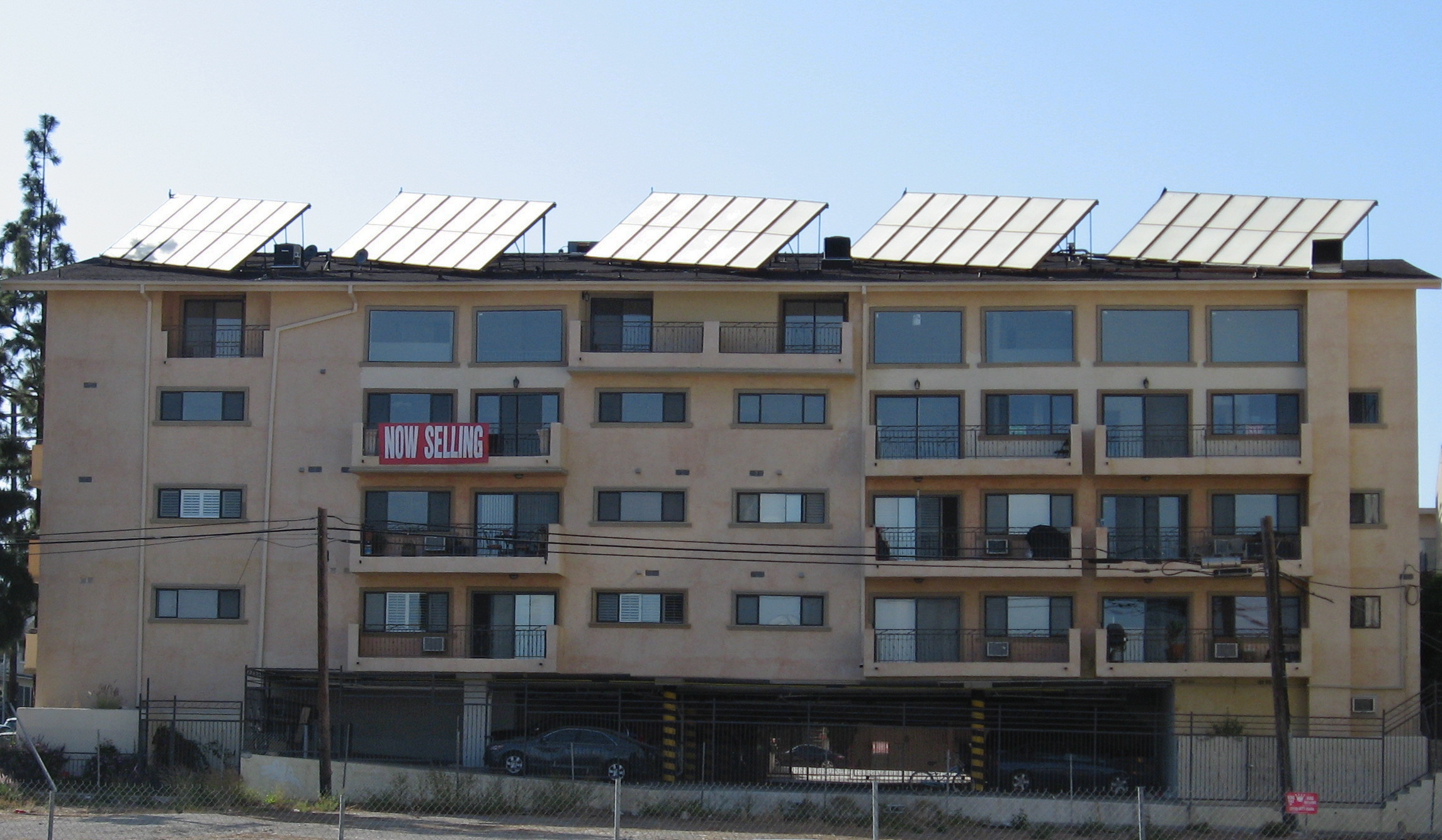
The photovoltaic market in Poland has expanded significantly since 2019, and the range of panel technologies available to residential buyers has grown accordingly. Choosing between monocrystalline, polycrystalline, and thin-film modules involves evaluating roof area, local shading conditions, budget constraints, and long-term energy yield expectations. This article provides a factual comparison of the three main technologies based on publicly available technical data and Polish installation practice.
Monocrystalline Silicon Panels
Monocrystalline panels are produced from a single continuous crystal structure, which gives them a uniform dark appearance and the highest conversion efficiency among standard silicon module types. Commercial residential panels in this category typically achieve 20–24% efficiency under standard test conditions (STC), with some premium models reaching 22–24% through PERC (Passivated Emitter and Rear Cell) or TOPCon (Tunnel Oxide Passivated Contact) cell architectures.
Performance characteristics
In Polish climatic conditions, monocrystalline panels demonstrate good performance during the lower-irradiance months (October–February) because of their relatively low temperature coefficient, typically around −0.35% per °C. This means output loss during summer heat is more contained than in some competing technologies.
Standard product warranties for monocrystalline panels include a 10–12 year product guarantee and a 25–30 year linear performance guarantee, with most manufacturers committing to at least 80% of rated output at year 25.
Cost and suitability
As of early 2026, monocrystalline panels in the Polish market range from approximately PLN 500 to PLN 900 per panel (300–450 Wp), depending on manufacturer and tier classification. They are the preferred choice when available roof area is limited, since higher efficiency allows more kilowatt-peak capacity per square metre.
Quick Reference: Monocrystalline
- Efficiency: 20–24% (STC)
- Temperature coefficient: approx. −0.35%/°C
- Product warranty: 10–12 years
- Performance warranty: 25–30 years
- Appearance: Uniform black or dark blue
- Best for: Limited roof areas, south-facing pitches
Polycrystalline Silicon Panels
Polycrystalline panels are manufactured by melting multiple silicon fragments together, producing a characteristic blue, speckled surface caused by the irregular crystal grain boundaries. This process is less energy-intensive than growing single-crystal ingots, historically making polycrystalline modules cheaper per panel.
Efficiency and temperature behaviour
Efficiency for standard residential polycrystalline modules sits between 15–18%, noticeably lower than monocrystalline equivalents. The temperature coefficient is slightly worse, at approximately −0.40%/°C, meaning high summer temperatures reduce output marginally more. However, for roofs with ample unshaded surface area, the lower cost per panel can offset the efficiency gap.
Market position in Poland
Polycrystalline's share of new residential installations in Poland has declined steadily since 2021 as monocrystalline prices fell. According to data from the Polish Photovoltaic Industry Association (PTPV), monocrystalline panels now account for more than 75% of new residential installations by capacity. However, polycrystalline remains relevant for retrofit projects where existing frames or inverters are optimised for slightly older panel specifications.
Quick Reference: Polycrystalline
- Efficiency: 15–18% (STC)
- Temperature coefficient: approx. −0.40%/°C
- Product warranty: 10 years
- Performance warranty: 25 years
- Appearance: Blue, speckled crystalline surface
- Best for: Large roof areas, budget-conscious installations
Thin-Film Photovoltaic Modules
Thin-film technology deposits one or more thin layers of photovoltaic material onto a glass, plastic, or metal substrate. The most commercially common types are Cadmium Telluride (CdTe), Copper Indium Gallium Selenide (CIGS), and amorphous silicon (a-Si). Each has distinct properties, but all share the characteristic of much lower material usage per module compared to crystalline silicon.
Residential applications in Poland
Thin-film modules for residential use in Poland are a niche segment. Their efficiency (10–14% for most commercial CIGS modules, 9–11% for CdTe) means larger roof coverage is required for the same output. They are used primarily on flat or very shallow roofs, on building-integrated photovoltaics (BIPV) applications such as solar tiles or facade cladding, and in cases where roof load-bearing capacity is limited due to the modules' lower weight per panel.
Temperature and diffuse light performance
One documented advantage of thin-film modules — particularly CdTe and CIGS — is their lower temperature coefficient (as low as −0.25%/°C) and better performance under diffuse light conditions. In overcast northern Poland, where diffuse irradiance constitutes a higher fraction of annual solar resource, thin-film panels can partially close the efficiency gap with crystalline silicon.
According to the European Commission's PVGIS tool, annual horizontal global irradiation in central Poland (Warsaw region) averages approximately 1,050–1,100 kWh/m², with around 35% arriving as diffuse radiation.
Comparison Summary
The table below summarises the key parameters for each technology based on currently available residential products in Poland.
| Parameter | Monocrystalline | Polycrystalline | Thin-Film (CIGS) |
|---|---|---|---|
| Efficiency (STC) | 20–24% | 15–18% | 10–14% |
| Temp. coefficient | −0.35%/°C | −0.40%/°C | −0.25%/°C |
| Product warranty | 10–12 years | 10 years | 10 years |
| Performance warranty | 25–30 years | 25 years | 25 years |
| Best application | Small/medium roofs | Large flat roofs | BIPV, flat roofs |
Selecting a Panel Type for a Polish Residential Property
For a typical single-family home in Poland with a south-facing roof pitch of 30–45°, monocrystalline panels remain the default recommendation based on efficiency-to-area ratio. Properties with east-west roof configurations can install split-orientation systems with string inverters or microinverters to capture morning and afternoon production across both roof faces.
Homeowners with flat roofs have more flexibility in tilt angle and panel selection, and thin-film modules may reduce structural load concerns in older buildings. Before committing to any panel type, a licensed photovoltaic engineer should conduct a roof-load assessment, shading analysis using tools such as NREL PVWatts, and a yield simulation aligned with the local irradiance data from PVGIS.
Sources: Polish Photovoltaic Industry Association (PTPV), European Commission PVGIS, IEA Photovoltaic Power Systems Programme (PVPS).